

Introduction
At some point, every agency owner wonders: What tasks can I actually delegate?
Most agency owners realize they need help. Inboxes overflow, renewals stack up, and admin work grows while time shrinks.
You might worry that a VA could provide incorrect information or that a client could receive bad advice, making you wonder who is ultimately responsible.
It’s natural to be careful. In insurance, your license isn’t just a credential — it’s a responsibility. Anything involving clients is ultimately your responsibility.
Being careful doesn’t mean you have to do everything yourself. It means knowing where the boundaries are and making sure everyone sticks to their roles.
When you set clear boundaries, you can delegate with confidence and keep your agency protected.
Why the line exists
Insurance licenses ensure clients receive help from professionals who can explain coverage, assess risk, and recommend protection. That’s the agency owner’s job.
If someone without a license tries to do these tasks, clients might get advice from someone who isn’t properly trained, and the agency owner is still responsible. It’s easy for the line between support work and licensed work to get blurry.
But many compliance talks overlook that much agency work doesn’t require a license.
The goal isn’t to stop VAs from helping. It’s to make sure everyone does their part.
The agency owner’s license protects clients, and the VA protects the owner’s time. When everyone knows their role, everyone benefits. Here are some examples.
Where the line sits
Let’s break down which tasks go to whom.
Here’s a simple rule: If a task involves interpreting coverage, giving advice, or making decisions about policy terms, a licensed professional should do it. Paperwork, organizing info, or following set processes can go to a VA.
Here’s how that breaks down in practice:
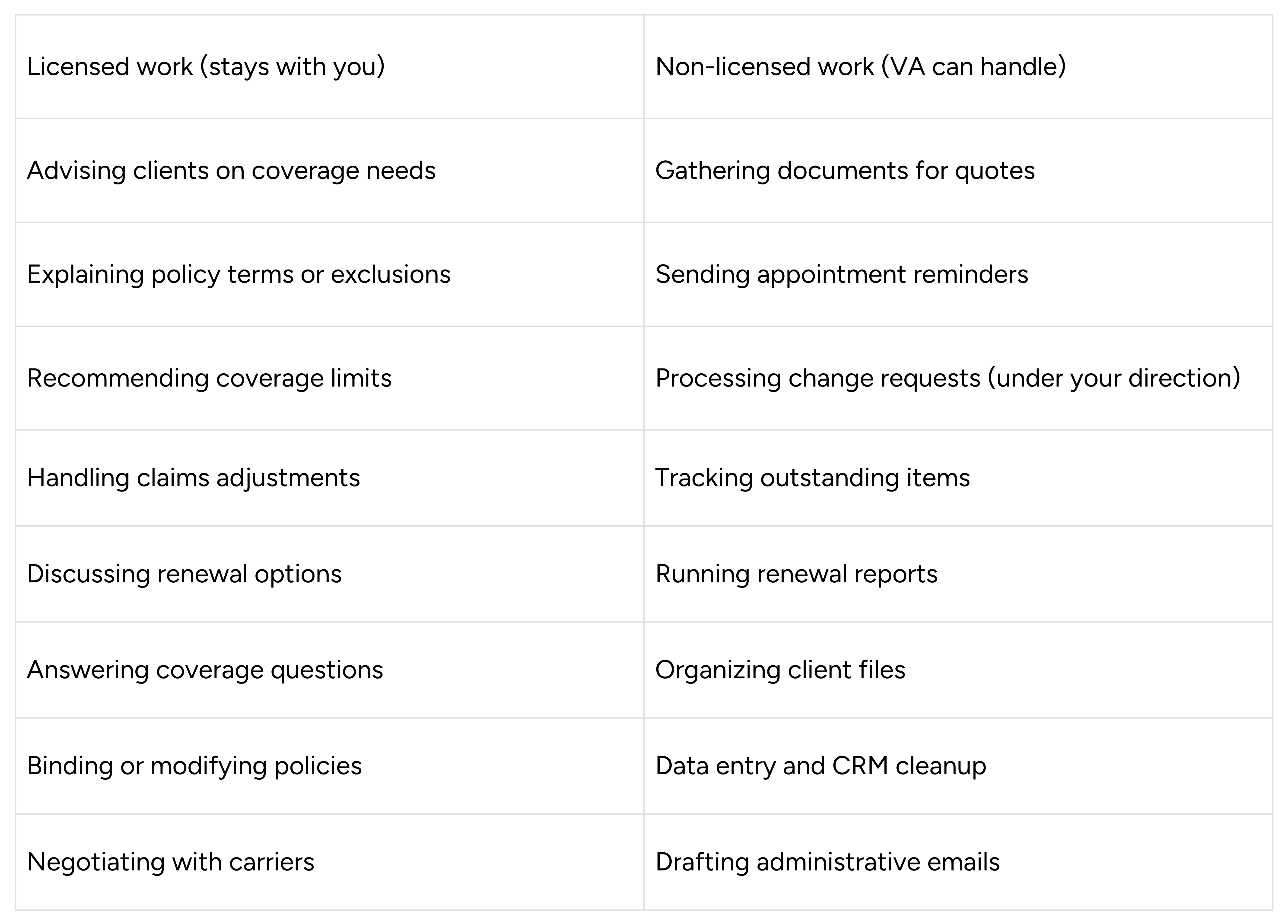
See the pattern? Tasks that need judgment stay with you. Tasks that just need to be done can go to the VA.
A VA can prepare files, but you review them. VAs send reminders, but you talk to clients. VAs track what’s outstanding, but you decide what happens next.
This way, duties are clearly separated, though sometimes things aren’t black-and-white.
The gray areas (and how to handle them)
In real life, some tasks sit right on the line between licensed and unlicensed work, so you’ll need to think carefully about who should handle them.
For example, if a client asks about a renewal date, the VA can give that info. But if the client wants advice about increasing coverage, you should handle it.
In the same way, a VA can fill out forms with client info, but you need to decide on the coverage type first.
The key is to teach VAs the difference between admin and advisory tasks. They don’t need to make the call themselves; they just need to know when to bring things to you.
The goal isn’t for the VA to do everything, but to make sure they know their role. Clear boundaries bring other benefits too.
Why boundaries actually build trust
Here’s something that surprises many agency owners who haven’t delegated before.
Setting clear boundaries with a VA actually builds trust, not the other way around.
If a VA isn’t sure about boundaries, they might avoid risks and slow things down, or guess and make mistakes. Neither helps build confidence.
When everyone knows their role — like “The VA gathers, the owner advises; the VA tracks, the owner decides; the VA prepares, the owner presents” — it’s clear what each person does. This helps the VA work confidently, lets you focus on your expertise, and ensures clients get quick, accurate service.
Boundaries aren’t restrictions — they’re what make delegation possible.
With clear boundaries, the VA can focus on support, and you can focus on your clients.
How SecureEVAs approaches this
Most VAs are good at admin tasks like scheduling and organizing, but they don’t know insurance.
This setup might work for some agencies, but it usually means the agency owner has to spend a lot of time training VAs on industry details and boundaries.
SecureEVAs takes a different approach. Our VAs get insurance-specific training before they start with your agency. They know the difference between admin and licensed work, so they can handle the right tasks confidently from day one.
This means VAs start their roles knowing which tasks need your expertise and which they can do on their own. You spend less time overseeing and more time on big-picture work.
The result? A VA who learns quickly, works confidently, and respects boundaries. Here’s how you can use the same approach in your agency.
A simple test for any task
Here’s a simple way to decide who should do what: ask yourself two questions.
1. Does this task need an insurance license? If yes, you keep it. If not, you can delegate it.
2. Does it need your professional judgment about a client’s situation? If yes, you handle it. If not, the VA can probably do it with clear instructions.
These two questions clear up most confusion. They show what needs your attention and what just needs to get done.
Want a clearer picture of what you can confidently hand off? Check out our blog, “Ten things your VA can do (so you can actually focus on clients),” for practical examples of tasks a well-trained VA can take off your plate.
What this looks like in practice
With clear boundaries, a typical day might have the VA handling routine questions, like checking renewal dates and replying with facts, while keeping you in the loop. If a client asks for advice, like whether to increase liability limits, the VA flags it for you and sets up a follow-up. For documents, the VA finds missing items, sends reminders, and gets the file ready for your review.
By week’s end, you’ve handled all client conversations that need your expertise, skipped unnecessary paperwork, and kept your agency running smoothly.
The goal isn’t to replace you with a VA, but to make your agency more effective by delegating the right tasks. It’s all about making roles work more efficiently.
Pro Tip: Build Trust by Over-Communicating Boundaries
Set clear boundaries with your VA from the start and review them often. Check in on their responsibilities after new projects or client conversations, and encourage them to ask open questions. When VAs feel comfortable clarifying boundaries, mistakes drop and trust grows.
The bottom line
An agency owner's license is a valuable asset, enabling the provision of advisory services, protection, and client support in ways unavailable to unlicensed individuals. Safeguarding this credential is essential.
You don’t have to do everything yourself to protect your license. When you clearly define responsibilities, you can delegate and run your agency more efficiently.
A well-trained VA who knows the boundaries is a real asset. They handle the details while you provide the expertise, so clients get both efficient service and professional advice.
This setup lets you take back time for the important work only you can do, showing how valuable good VA support can be.
You don’t have to do everything yourself. Learn how to set clear boundaries with your VA and streamline your agency’s operations without compromising your license. Talk to an expert.